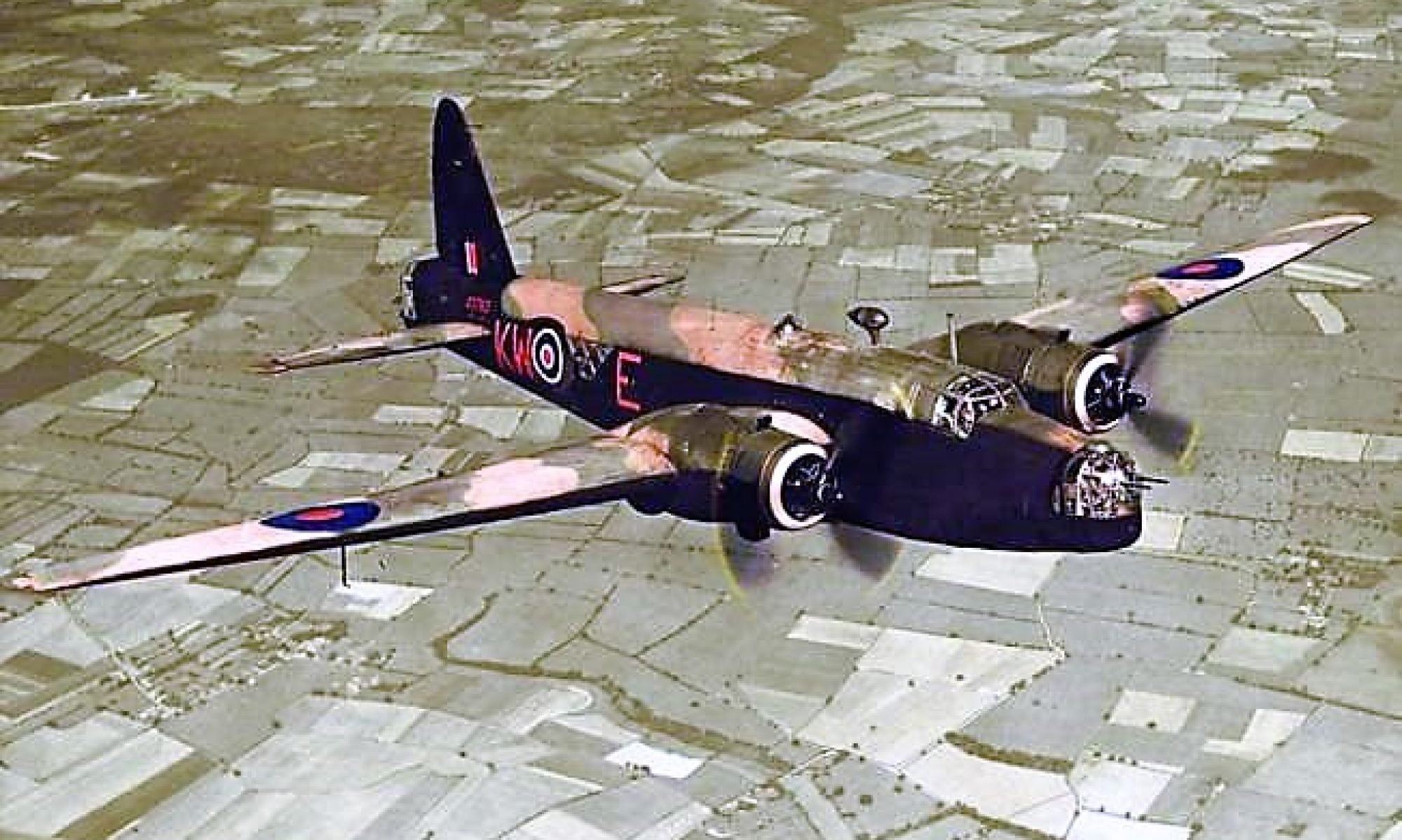
Handley Page Halifax NP957 KW-Q « Ville de Québec »

Photos from the collection of Réal St-Amour courtesy Chantal St-Amour

KW-Q                     

Handley Page Halifax NP957                  

The nose art survives today in the War Museum in Ottawa. Handley Page Halifax NP957 first served with No. 427 Squadron 13 September 1944, to 429 Squadron  on 1 March 1945, then to 425 Squadron on 16 March 45, flying ten operations and received nose art « Ville de Quebec » from crew of P/O Kolisnek, who flew her eight operations.

Disposal 6 May 1945, scrapped 14 May 1945.

KW-Q Ville de Québec


Joe Lecomte

Handley Page Halifax Ville de Québec


Halifax Ville de Québec


KW-P « Pistol Packing Peggy »

Pistol Packing Peggy

KW-P

Collection Réal St-Amour courtesy Chantal St-Amour

No. 425 (Alouette) Squadron returned from North Africa (No. 331 RCAF Group) between 26 October and 5 November 1943. The squadron returned to England leaving all Wellington Mk X aircraft in Tunisia. Arriving at No. 62 Base at Tholthorpe, Yorkshire, on 10 December 1943, the unit began to receive new Handley Page Halifax Mk. III aircraft.

Halifax serial LW375 was from a batch of 37 Mk. III’s built between 27 October and 23 November 1943. Assigned to No. 425 Squadron in mid-December 1943, the bomber was flown by different crews in squadron training. In early February 1944, LW375 was assigned to the crew of pilot Tom Rance.

Pilot Tom Rance
Bomb/Aim. Jack Stokes
Wireless/Op. Bob Whyte
Mid/Upper Gun Len McDonald
Nav. Norman Marshall (American)
Flight/Eng. Bim Wall (British)
Tail/Gun Bill Osborne

The squadron assigned code letters KW-P to the aircraft and the crew decided to call their bomber “Pistol Packing Peggy”. The squadron Nose Artist picked a lady that first appeared as the October 1942 Varga pin-up in the magazine Esquire.

Bomb aimer Jack Stokes completed a total of fifteen operations in “Peggy” and received a very close call at the end of March 1944. The 30/31 March raid on Nuremberg cost Bomber Command 96 bombers. 118 RCAF bombers were dispatched and 13 were shot down. Halifax “Peggy” was approaching the target area with Jack on his belly looking through the bomb sight when the aircraft was hit by 20 mm fire from a German night fighter. The hole in the Halifax was 3 inches in diameter, with the projectile travelling upwards between Jack Stokes right hand and the right side of his face. Part of his leather glove and skin was missing from his right thumb, and he received a scratch along the right side of his face.

On 31 May/1 June 1944, “Peggy” was one of 125 Canadian bombers that attacked Au Fevre, a German radar site in France. Approaching France, the Halifax ran into a huge thunder storm and, after attempting to go around the storm, they were too late arriving over the target. The crew were ordered not to jettison their bomb load over the English Channel, possibly due to the upcoming D-Day landings. Upon landing at base the Halifax under carriage collapsed and the bomber was damaged. That was the last Jack saw of his Halifax “Peggy”.

The Halifax was later repaired and flew with No. 296 Squadron R.A.F., then went to No. 1355 Heavy conversion Squadron. LW375 was struck off charge by the R.A.F. on 19 August 1946 and scrapped.


Source: http://dunrobincastle.com/Nose_Art/pistol_packin_peggy.htm
Le voyage dans le temps des Alouettes – Le mid-upper gunner Philippe Clouthier

L’histoire des Alouettes que je raconte depuis 2010 se poursuit maintenant ici grâce à ceux et à celles qui partageront les souvenirs de guerre de leur père, de leur frère, de leur oncle, de leur grand-père…

retour de mission

Clouthier
J. P.
R/268577
Flight Sergeant
Mid-Upper Gunner
équipage J.T.G. Hallé

Un message…

Dans une de vos publications antérieures (deux ou trois semaines), il y avait une photo d’un équipage de Tholthorpe dans lequel paraissait un rear-gunner appelé Holowaty.

Mon père, Philippe Clouthier, était originaire de Rawdon, mais demeurait à Saint-Sauveur-des-Monts au moment de son engagement. Du 6 Group, il a été affecté à Tholthorpe comme mitrailleur (upper mid-gunner) au printemps de 1945, puis formé, comme bien d’autres, pour ramener les Lancaster au Canada.

Le numéro du périodique Air Force intitulé ‘The Last Requiem’ raconte la triste histoire de ce Holowaty qui est mort accidentellement aux Îles Açores, alors que les gars étaient sur le chemin du retour à la maison. Mon père se trouvait dans l’avion qui a percuté Holowaty dans son habitacle.

Je joins aussi une photo de mon père sans doute au retour d’une mission sur un Halifax, ainsi que celle d’un Halifax portant le nom de Shoo Shoo Baby que mon père avait conservée. J’ignore si c’était son avion ou un autre qu’il aurait pu trouver intéressant en raison de la chanson populaire à l’époque.

Mon père est décédé en 2010 à la Maison Paul-Triquet à Ste-Foy.

Cordialement,

Jean Clouthier

2017-03-14-14-58-11

16 mai 1944 – La visite du Premier Ministre

Je me souviens de ce que Jean-Paul Corbeil m’avait raconté au sujet du Premier Ministre. Ce message d’un collaborateur me rappelle ce que Jean-Paul Corbeil m’avait dit de son voyage en train dans le nord de l’Angleterre pour aller ramasser les cadavres d’aviateurs.

Il venait tout juste d’arriver à Tholthorpe.

Salut Pierre,
Tholthorpe, 16 mai 1944, visite du P.M. Mackenzie King.
Sur la photo UK10923, quelqu’un avait écrit « Massey », sans doute pour le civil à l’arrière du Premier Ministre. C’est plutôt Walter James Turnbull, qui était en mai 1944 le secrétaire privé de MacKenzie King. À droite de Breadner c’est le G/C J.L. Hurley qui était le commandant de Tholthorpe à la même date.


Time travelling with les Alouettes

I have been writing the history of the Alouettes since 2010 thanks to those who have shared the war memories of their father, brother, uncle, grandfather…

IMG_0469

Several veterans also shared their war memories with me: Jean-Paul Corbeil, Jacques Morin, Bernard Racicot and Jean Cauchy.

Since 2010, I have been travelling back in time and revisiting  the glorious past of the Alouettes squadron.

logo escadron 425


The story of the Alouettes will then continue here, due to lack of space on the second blog to add photos like these photos of headstones taken by the nephew of Louis Renaud when he visited his uncle’s grave in Germany…


Le voyage dans le temps des Alouettes

L’histoire des Alouettes je la raconte depuis 2010 grâce à ceux et à celles qui ont partagé les souvenirs de guerre de leur père, de leur frère, de leur oncle, de leur grand-père…

IMG_0469

Plusieurs vétérans ont aussi partagé leurs souvenirs de guerre avec moi : Jean-Paul Corbeil, Jacques Morin, Bernard Racicot et Jean Cauchy.

Depuis 2010, je voyage dans le temps et je fais revivre le passé glorieux de l’escadrille Alouettes.
logo escadron 425

L’histoire des Alouettes se continuera alors ici, faute de place sur le deuxième blogue pour y ajouter des photos comme celles-ci…

Concevoir un site comme celui-ci avec WordPress.com
Commencer