
With the collaboration of Jean Clouthier
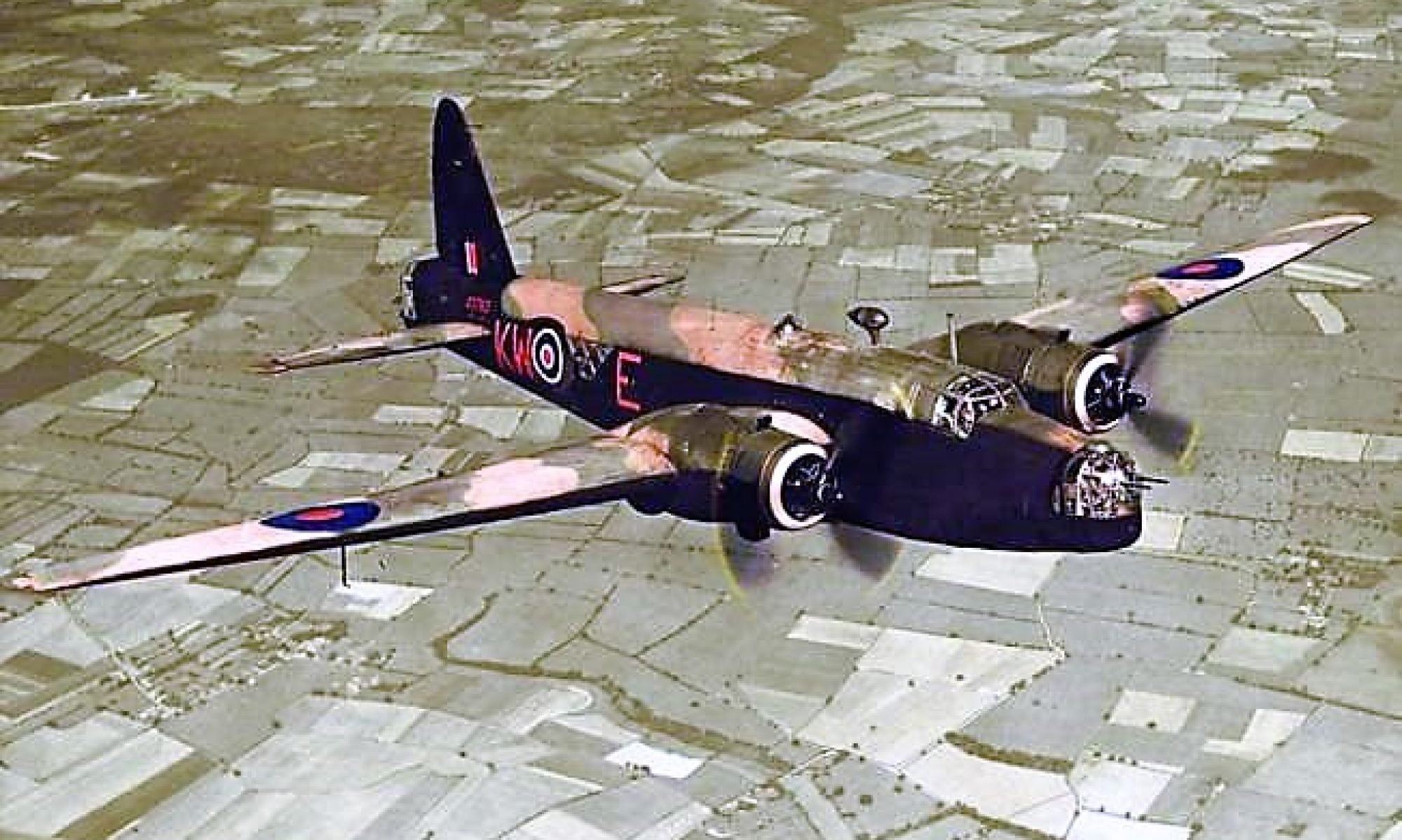
Jean Clouthier’s father was an air gunner on Lancaster KW-G. Jean shared Bernard Marcoux’s story. Bernard Marcoux was also on board the Lancaster KW-G which struck the Lancaster KW-I. Bernard Marcoux was a wireless air gunner.
The following is an article published in the Spring 1995 issue of Airforce magazine. I had translated it in French last month.

With the kind permission of Airforce magazine
The Last Requiem
By Bernard Marcoux
Fifty years ago on Tuesday, 1 May 1945, under a delightful sunny sky, a number of new Lancaster Mark 10 heavy bombers were delivered to 425 Alouette Squadron stationed at Tholthorpe in Yorkshire. England. Manufactured by Victory Aircraft of Malton, Ontario, these planes were destined to replace the Halifaxes which by then were considered obsolete. Powered by four Rolls-Royce Merlin engines, the Lancaster was then the most formidable heavy bomber in the world. It alone could carry the deep penetration bombs weighing 12,000 lbs. It bettered the payload capacity of the American B-17 Flying Fortress by more than 5,000 lbs, and with special fittings could even handle a giant 22,000 lb « Grand Slam » bomb.
After two full days of tedious classroom instructions, the flying phase of our conversion programme to the new aircraft began. It all started with manoeuvres popularly known as « circuits and bumps. » We non-pilots had to suffer through this ordeal as passengers, crouched bravely for landings in the prescribed crash position, sometimes silently offering alms to the Almighty.
During the training sessions, the crews worked at improving skills, quickly becoming more familiar with the equipment, controls, and instruments of the Lancaster. After some 30 hours of flying time accumulated in a dozen night and day cross-country flights, S/L R. Laporte, officer commanding « B » Flight, confirmed our competence to fly the Lancaster.
Germany surrendered on 8 May 1945. Following two days of celebrations befitting this grand event, the Alouettes were invited to join 661 Wing, called « Tiger Force, » a very long-range heavy bomber force consisting of eight Canadian Lancaster squadrons, 405 « Vancouver, » 408 « Goose, » 419 « Moose. » 420 « Snowy Owl, » 428 « Ghost, » 431 « Iroquois, » 434 « Bluenose, » and 425 « Alouette » Squadrons. This bomber force was to join the Americans in the Far East to finish the war with the Japanese. But first a bonus: we were to fly home with our Lancasters, enjoy a « furlough » at home, then regroup on bases in New Brunswick and Nova Scotia.
My crew was allocated Lancaster « KW-G, » serial number KB-936, which we successfully air-tested on Saturday, 9 Jun 1945, in preparation for our flight to Canada. The following Wednesday morning, along with the rest of the squadron, we took off for the very last time from Tholthorpe, the base we had shared with 420 Squadron since December 1943. The first leg of our journey took us down to the Midlands, across the Bristol Channel that separates Wales from Cornwall, then along the picturesque Cornish coast to St Mawgan, our springboard to Canada.
The navigational aid called « Gee, » used extensively over continental Europe by crews of Bomber Command, could not be exploited west of the British Isles. For this reason, our navigator, F/L George Leroux who was skilled in astro-navigation, was appointed chief navigator for the entire wing.
The next morning, 10 days into the 20th year of my life, the sky of Cornwall was covered with thick grey clouds. Furthermore, the meteorological forecast for the Azores, our stepping-stone to Gander, was not at all favourable.
After some reflection it was observed that the bulk of the unpleasant weather system could be avoided if we left before 1100 hrs that morning. A « go » decision was taken and soon we said goodbye to England.
Shortly afterwards we kept our rendezvous with the rest of the squadron at 8,000 feet, and led by Leroux headed toward the Scilly Islands off Land’s End, the last bit of land we were to see before reaching the Azores. The H2S radar screen showed clearly the profile of the Scilly Islands, giving George a superb opportunity to get a final solid land « fix » with which to confirm our position. The weather forecast was accurate. Throughout our south-westerly flight to the Azores, a solid cloud layer at 5,000 feet kept the ocean from our view. This we thought was boring as hell, but when we were flying home in a brand new Lancaster doing 230 miles per hour under a sunny sky that hid no enemy fighters and with no flak to boot, things could hardly have been better! Leroux kept busy taking hourly sextant sights on the sun, with which he obtained single position lines that produced what he called our « most probable » position! Later, our position over the ocean was more accurately determined when a cone-like mass was sighted rising out of the cloud over our starboard wing. This was readily identified as Pico, a volcanic island in the Azores Archipelago that reaches a height of 8,000 feet. Eventually we came within radio range of Lagens Airport (now named Lajes) and the additional data I received helped to confirm our position relative to our destination.
Since the island of Terceira, on which the airport is located, was completely obscured by cloud, we used our radar to navigate a safe descent. After flying for six-and-a-half hours, our skipper, F/O Gérald Hallé, deposited KW-G gently on the longest runway we had ever seen. This « highway », we learned later, stretched no less than 10,000 feet. With little or no braking, we managed to use up almost one third of its surface. WOW!
As we rolled along to our dispersal site we realized how busy Lagens really was. This beehive of activity conveniently located in mid-Atlantic, 1,000 miles from the eastern seaboard of North America, was the master platform from which supplies were routed to and from the European war theatre. Built by Britain on land leased from Portugal, the base was the focal point for sea and air cargo movements to both continents.
Unaware of the tragedy that Fate reserved for us, we took KW-G to its assigned parking spot, shut down the engines and with shaving kits in hand, left the kite in the care of the local ground crews. As it was intended that the squadron would continue on to Gander later the same evening, we hurried to the mess hall for a snack, then made our way to sleeping quarters where we had a short rest. Later that night at briefing we were given the usual menu of flight instructions, weather maps, wind data, radio frequencies, local take-off protocol and finally, the landing procedure for Gander.
The bus drivers who ushered our Alouettes to their planes never had a more spirited bunch of passengers. We sang our songs, made merry, laughed at our jokes and tried hard to let the whole world know that the Alouette were on Terceira land. We hoarded KW-G and made her ready for our flight home. One after another, each Merlin was started, warmed up and fine-tuned by F/O Hallé and Sgt R.J. Laroche, our flight engineer. While I synchronized the radio receiver, loaded the transmitter finals, checked the antenna system and my oxygen supply, F/L Leroux completed the calculations necessary for our first compass setting. Meanwhile, F/S Ray Sabourin and Sgt P.J. Clouthier, respectively rear and mid-upper air gunner, checked their turrets and oxygen supply. Up front, F/O Routhier the bomb aimer verified that the H2S set functioned correctly, and that the oxygen supply was adequate.
We got the « OK » to move off, and soon KW-G was moving ahead on its way out of the dispersal area. As if they too were anxious to get going, the chorus of I00 Merlin engines roared loudly in the night. Outside, the conditions were not good. With heavy clouds, the night sky revealed very little light, providing visibility that ran erratically from poor to zero.
Carefully, Hallé squeezed KW-G into the forming queue directly behind KW-I, another Alouette kite skippered by F/L H.C. Chappell. Without headlights, following a jeep sporting a « Follow Me » sign, like a caterpillar attracted by some invisible lure, the string of Lancaster laboriously inched its way toward the runway.
The manoeuvre was normal and we had done it many times before. Good night vision, after all, is an endowment that all pilots proudly claim.
As we neared the edge of the runway, conditions worsened and visibility became even more sporadic, a condition probably caused by the dust and sand raised by our own prop-wash.
The progress we made was annoyingly slow. After all we were on our way home and the excitement was high. We were done with Hitler. May his dead body rot in Hell, screw Germany, and all Europe… our next beer will be a good old Black Horse, not this hot piss the Brits call bitter. In a few hours the coming-home parties… Look out Montreal! The Alouettes are coming!
But destiny intervened, and in the next instant our exhilaration turned to stark terror.
Seeing the sign move forward once more, Hallé released the brakes allowing KW-G to lunge freely forward. In a moment, immediately under the right side of our nose, the black and immobile mass of KW-I’s tail section suddenly appeared, the jeep having gone past the port fin of KW-I’s tail section, with its « Follow Me » sign still on. In haste Hallé squeezed the brakes, but the momentum of our 63,000 lb Lancaster was implacable and allowed it to travel a few more tragic feet; enough for our starboard inner airscrew to crash into the fuselage of the other ship, tearing, crushing and smashing everything in its path, sparing nothing, especially KW-I’s rear turret where F/S Bill Holowaty had just settled in preparation for take-off.
For what seemed an eternity, the merciless propeller, driven by its powerful 1620 HP Merlin, kept whirling in its inexorable, uncontrolled, destructive journey. In fact, however, Hallé’s reaction was swift and professional. The moment he realized that a « prang » was unavoidable, he immediately throttled back and switched off all engines. In less than two minutes actual time, all became quiet. Fearing a possible fire, the skipper ordered the crew out of the plane. As we disembarked and blindly searched the darkness, F/S Tommy Sinclair, KW-I’s WAG, wisely fired a Very flare. It exploded high over our heads and for a time the sky of Lagens became luminescent with an intense red glow, a visual « mayday » call for help.
The red flare stopped all airport traffic and immediately alerted the emergency ground personnel. Soon we were joined by KW-I’s crew and the emergency response personnel who rushed to the scene in jeeps, trucks and fire wagons. Holowaty, we were shocked to learn, had been grievously injured and was now receiving first aid.
In the eerie light of headlamps and with great difficulty, his broken body was extricated from the crushed turret and rushed to sick-bay.
Confused and shaken we watched as they towed our damaged Lancaster to the side, making way for the other planes to proceed on to the runway.
This time however, they were thankfully escorted by ground vehicles, headlamps shining brilliantly until the last Lancaster had safely reached the runway. Meanwhile air traffic resumed and sweepers picked up the debris and cleaned up. The bus trip back to base was made in silence and with heavy hearts as we heard our Lancasters humming away up there on their happy journey home.
During the following two days, a formal military inquiry was conducted by a Royal Air Force officers’ court. The presiding judge allowed that the court could find no fault and consequently ruled that no blame would be attributed.
F/S Bill Holowaty died of his injuries during the early hours of Monday, I5 June 1945. The next day, under a sunny and friendlier sky, he was buried in a small cemetery not far from the great runway we had so much wanted to reach. A touching funeral service conducted by the resident chaplain was attended by the members of both crews and other Canadians on duty in Lagens.
The tragic death of F/S Holowaty was manifestly sad. It came, the result of a minor accident, at a time when he, a young veteran, vibrant and full of life, was travelling home to reunite with his family in Rochester, a small community north of Edmonton. It was doubly unfortunate because the record of this fatality was to be the very last entry in the log of casualties suffered by 425 Alouette Squadron and by 6 Group, Bomber Command during World War II.
(Ed note: Bernard Marcoux of Alliston, Ontario. was a wireless air gunner during WWII.)

F/O Gerry Hallé inspects engine repairs done on Lancaster KW-G by LAC Parson (left) and LAC Harris (not in picture) after its fateful ground collision with Lancaster KW-1 in the Azores.

The crew of Lancaster KW-G during repairs to their aircraft following the accident in the Azores. From top are: F/O J.R. Routhier, bomb aimer, Sgt Ray Sabourin, rear gunner, F/O Gerry Hallé, skipper, F/L George Leroux, navigator and author WO Bernard Marcoux, wireless air gunner. Partially seen on scaffold is Sgt R.J. Laroche, flight engineer. Missing from photo is Sgt P.J. Clouthier, mid upper gunner.
Note
Information from Jean Clouthier
Sergeant P.J. Clouthier, mid-upper gunner, is not in the picture because his father was the one who took the picture.
Images taken from William Holowaty’s military file


Lest We Forget…


Collection Réal St-Amour
 RCAF 425 Alouettes III