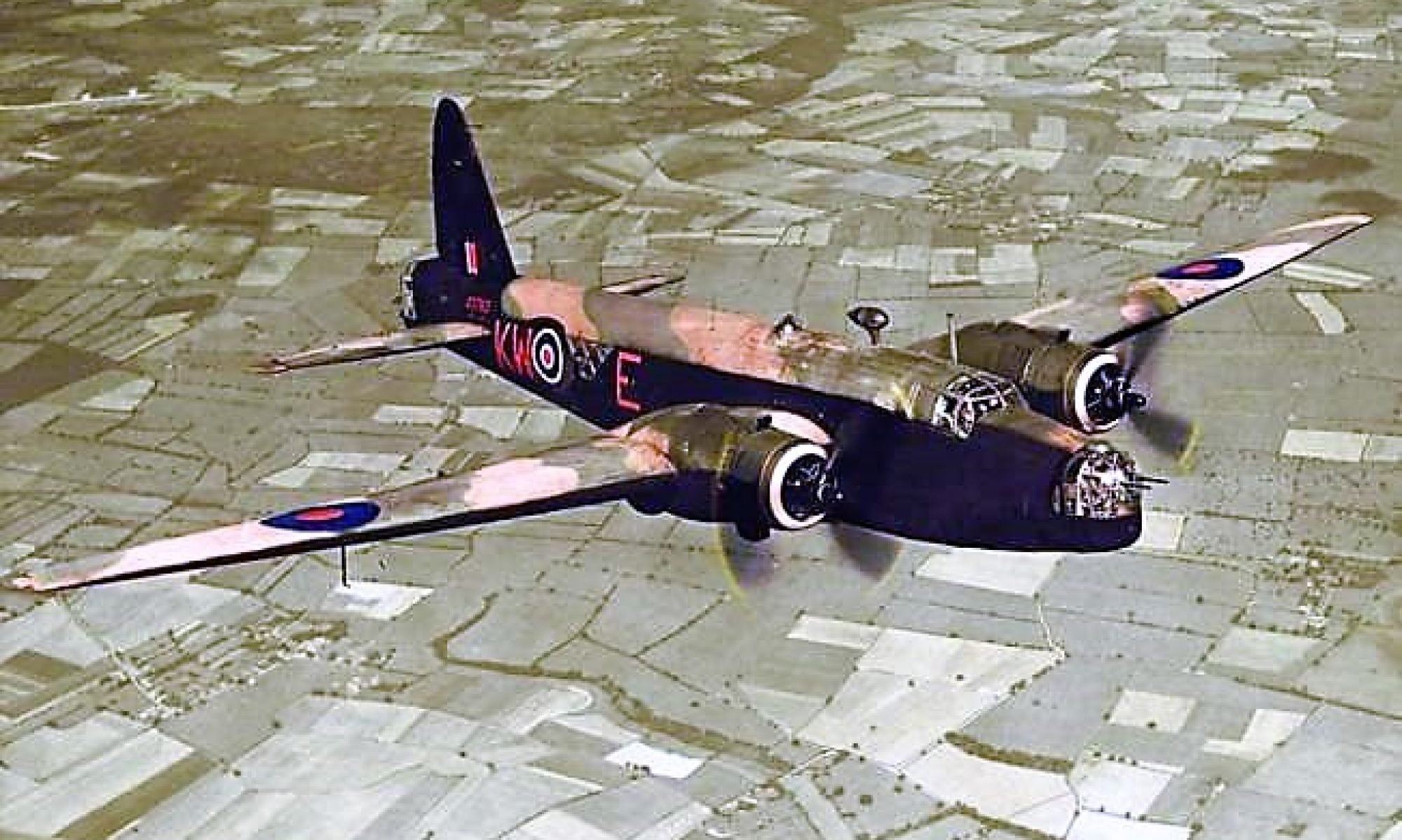


Mise à jour avec cette photo colorisée par Denis Thievin.

De la fille d’Antoine (Tony) Brassard DFC

De gauche à droite (tel que décrit par mon père dans une lettre envoyée à ma mère)
Jean (Jonny) Bourque de Montréal, navigateur. «Jeune homme sérieux avec beaucoup de plomb dans la tête».
R. Fuller d’Angleterre, ingénieur. «Exceptionnellement mon ingénieur était anglais, on manquait d’ingénieurs canadiens-français».
Gérard (Jerry) Lalonde, de Valleyfield, mitrailleur dorsal. «Très spirituel. C’est lui qui nous fait rigoler».
Georges (Blondy) Alarie de St-Jérome, Terrebonne, mitrailleur arrière. »Très jeune et très sensible«».
Antoine (Tony) Brassard de Strickland (Ontario), pilote et capitaine de l’équipage.
Philippe (Berny) Bernatchez de Baie-Comeau, bombardier (bomb aimer ou viseur de lance bombe). «C’est un type très intelligent. Il aime beaucoup taquiner mais se fait prendre dans son propre jeu».
Aimé Thievin de Saskatchewan, sans filiste. «C’est notre gars à tout faire, il est très adroit. Il travaille cinq minutes dans ta bicyclette et les cinq minutes suivantes dans ta montre».

Lloyd « Lucky Red » Stanley Lafoy, my Grandfather, enlisted in the RCAF in 1941 and like his sister, Violet Lafoy, hoped to work in the Mess Hall. Red only had a Grade 10 education and at that time one needed more to become an Airman. Losses were high however in the beginning of the war and Bomber Command lowered the entry standards allowing Red to enroll in Air Gunnery School in Paulson, Manitoba. An event that would change his life.
He would earn his Air Gunner Wing and by 1943 found himself in England assigned to 426 Thunderbird Squadron « On Wings of Fire ». His first pilot, Richard Talman, was a fellow Saskatchewan farm boy and would be Killed In Action flying as a « 2nd Dickey » (second pilot) with another crew training to take Red’s crew out. His bomber went down in Belgium and Talman’s grave is there now.


Red »s crew were now orphaned, without a pilot, and would be assigned to a new pilot, Felix-Henri « Turk » Turcotte, flying Wellington bombers over Europe and spend some time in North Africa bombing Italy.


They returned to England by ship and Red remembered that Air Gunners were always assigned to Submarine watch duty.
Back in the UK Red’s crew switched to flying Halifax MK III bombers with 425 Alouette Squadron « Je te plumerai » or « I shall pluck you » of No. 6 Group of Bomber Command.


Turcotte was not comfortable flying the Halifax however and the crew would disband for reassignment to new crews. Red would spend many months flying with Wing Commander Lucien « Joe the C.O. » Lecomte as his pilot.

They would bomb France, Belgium, and Germany for the duration of the war as Red completed his tour (30 missions).
Red would finish the war with 35 missions completed and was awaiting placement in the Pacific Theatre when the US would drop the atomic bombs ending the war.
To put things in perspective, Bomber Command lost a total of 8,325 aircraft. The crews also suffered a high casualty rate: 55,573 were killed out of a total of 125,000 aircrew, a 44.4% death rate. A further 8,403 men were wounded in action, and 9,838 became prisoners of war. During the RCAF’s Halifax operations between March 1943 and February 1944, the average loss rate was 6.05%, producing a mere 16% survival rate for a tour of 30 operations.
Red indeed was « Lucky » but always attributed his survival to the skill of his pilots. Talman was the only Airmen of his crews not to survive and Red never forgot him despite their brief history. He can be seen pointing to Spud’s name on the Bomber Command Memorial in Alberta.

Sargeant Richard « Spud » Elwood Talman – 20 years old, KIA, buried in Brussels Town Cemetery, Belgium. Son of Marion Hobart Talman and Annie Marguerite Talman, of Fertile, Saskatchewan, Canada.
Sadly « Red » passed away February 18, 2019 after a life well lived … and earned.

Lest We Forget.
Che Lafoy
I told Alex Fox I knew someone who knows more about 425 Alouettes than myself.


From The Memory Project
Your first run, you have to go with another crew, one trip, and then you go with your own crew. And that’s all. They just send you out, they tell you, they have a briefing and they tell you where you’re going to bomb, your exact time over target and what the weather is, all the details they know. And then it takes you over two hours or more to get the thing off the ground. You’ve got to run up four engines separately until they’re warm and check them and then shut them down and, and so on. So it’s not fast and it’s an eight-hour run we did, eight hours up there. So altogether, you’re more than ten hours, which is a little long for some people, because that’s ten hours without eating, drinking or going to the bathroom. There is no bathroom. Besides, it wouldn’t do you any good with one pilot, you can’t leave the plane. You can’t walk under your … But that was the only thing you have to, it’s only for people that can last long times. It’s only for very calm people.
The last route we [425 Squadron] did was a kind of tragic one, that. It was on a daylight [run], not a night one, and it was a little island called Wangerooge [in the North Sea]. And we were, I think there were just gun emplacements that they had there. And that was our last flight, broad daylight [on April 25, 1945] and there was a lot of slipstream from one plane to another. You can’t see it though. So two planes ahead of me collided and of course, then they were lost, there’s seven [crew members] in each, so you lose all of them. They parachute out some of them but they were just going to end up in the ocean. And that was kind of tragic for the end when it was the very last run. But after I came back, a long time later, I found out that two other planes had collided on the same trip. There was no Germans anywhere near there, nobody shooting at us or anything, it was just collisions. That’s the main trouble we had. It wasn’t, in a movie, you see fighters, bombers chasing one another around. In actual fact, most of it is just collisions at night or something accidental, this is what happens to most people.
But we flew a box formation that was very difficult for them. You’d have to go through three or four or five bombers on the way through. So he [the enemy] isn’t going to make it likely going through to, attacking us. We didn’t fly the popular V formation, which is what the Americans did. And we did short raids. All our raids were ten minutes. But you were supposed to go over the exact minute they tell you, like H-hour plus three minutes or H plus three. You’re not supposed to go over any other time. And we had, a camera under the plane that took pictures, showed pictures of the bombs dropping, you could count them. And it showed the target, what was below. So they’d know from the trajectory of a bomb exactly where it would land. That’s before it landed. So next day, your plane, your number, G for George, would be shown on a map to show how many feet you missed, so they knew exactly how accurate we were. So it was done, it’s very exactly done. It wasn’t a random thing where you do just throw things out.
What you do is, the bomb aimer out the nose takes over. He tells you, you’re just about in line with the target and they all always said left twice -the word – so we didn’t mix it with right. So he’d say “left left steady, steady, then right, steady. A little farther to the right, steady”. And then he was the one that had an automatic bomb site with all the junk on it and he would say “bombs away”. Then you’d got to stay straight and level for just a few seconds while the cameras take the pictures and such. And then you’d dive out of there, that’s all. You’d never go over the target. First thing you do is jump up 300 feet, when you drop the bombs, your plane leaps up. Then the first thing you do is dive out of there at full speed, go as fast as you get out of there, and then pick your own height. Everybody flew at a different height so then they couldn’t find us on the way home; we were wandering all over the place, everybody would pick a different height.
And then some of them were in a hurry to go home and some of us used to slow them right down and go as slow as you could, on purpose. Because you were more likely to get there. You don’t want to burn up engines. Once you got there, there’s no hurry going home. That’s about all. So you’d coast them home.
Source: http://www.thememoryproject.com/stories/1187:douglas-john-doug-petrie/
Il y a une anecdote avec cette photo envoyée par le père Laplante à la mère de l’armurier Jean-Jacques Lavergne pour le temps des Fêtes 1944.

Le père Maurice Laplante avait écrit ceci à l’endos.

S.E. cardinal Villeneuve archevêque de Québec lors de sa visite aux Alouettes a été émerveillé de la pitié et du beau travail de nos petits Canadiens. Votre fils a sa large part de mérites dans ces éloges. Soyez-en félicitée.
Joyeux Noël bonne et heureuse année
Père Maurice Laplante omi
Aumônier de l’escadrille Alouettes 425 Angleterre
Jean-Jacques Lavergne voulait que je l’appelle…

Lundi, 22 juin, 10 heures…
Résumé de la conversation
Jean-Jacques Lavergne n’a été un Alouette finalement que deux semaines…
En 1943 il s’enrôle dans l’aviation bien qu’il se soit enrôlé auparavant dans la réserve des Fusiliers Mont-Royal. C’est en voyant des aviateurs vêtus de bleu lors d’une parade militaire qu’il décide de s’enrôler dans l’aviation.
Il se retrouve alors à Toronto, puis à Calgary dans une école de sans-filistes.
Il fait partie d’un groupe de 50 recrues. Lors de leur assignation outre-mer, 49 recrues sont choisis à l’exception de Jean-Jacques Lavergne. Comme il n’a pas encore ses 19 ans pour aller outre-mer, il ne peut suivre son groupe. Finalement, on lui demande s’il accepte de partir volontairement et il décide d’accepter.
Il se retrouve sur le Louis-Pasteur en avril 1944. La traversée dure sept jours avec plusieurs milliers de militaires. C’est là qu’il apprend à détester manger du mouton. Les douches sont à l’eau salée froide qui brûle la peau.
Il se retrouve ensuite à Bournemouth, puis dans des villes du sud de l’Angleterre. C’est là qu’il voit toute la préparation pour le Jour J avec plein de camions militaires dans les rues et les caisses de munitions qui s’empilent.
Jean-Jacques Lavergne, n’aura donc été un Alouette que deux semaines avant d’être affecté temporairement à l’escadrille 415 du Coastal Command. L’affectation temporaire durera jusqu’à la fin de la guerre.
Puis trois choix s’offrent à lui: la démobilisation, rester en Europe pour l’occupation ou partir pour le Pacifique. Il choisit la campagne contre les Japonais et revient au Canada sur l’Aquitania avec 12 000 militaires en direction d’Halifax.
Après un mois de congé, il doit se rendre à Greenwood en Nouvelle-Ecosse. À ce moment, les deux bombes atomiques mettent fin aux hostilités. Il se rend alors Moncton pour la démobilisation, ce qui met fin à la carrière militaire de l’aviateur-chef Jean-Jacques Lavergne.
L’anecdote de la photo du cardinal Villeneuve?
Le père Laplante envoyait la même aux tous les parents des Alouettes.
Jean-Jacques Lavergne était parti de Tholthorpe depuis longtemps.
Le 11 novembre 2019, Jean-Jacques Lavergne recevait des mains de Maxime Laporte la Médaille de l’Assemblée nationale. (Image prise sur le site de la SSJB)

Mise à jour 24 juin 2020, 17.00
Envoyés par un lecteur


Le Père Laplante avait envoyé cette photo à la mère de l’armurier Jean Jacques Lavergne.
Il avait écrit ceci à l’endos.
Jean-Jacques Lavergne m’a envoyé aussi ceci…
À suivre…
Lucien Marcotte DFC est à droite de Robert Bruyère.

Voici ses états de service et la citation pour sa DFC.
MARCOTTE, F/O Joseph Louis Albert Lucien (J86833) – Croix du service distingué dans l’aviation – Escadron n° 425 – Attribution en vigueur le 12 janvier 1945 selon la London Gazette de cette date et AFRO 471/45 du 16 mars 1945.
Né le 28 août 1915 à Montréal ; y réside ; s’est engagé le 11 juin 1942 dans un programme d’entraînement d’urgence en temps de guerre. Au dépôt d’effectifs n° 5, le 11 août 1942. Au 6e BGS, le 25 septembre 1942, au 3e ITS, le 4 janvier 1943 ; diplômé et promu à BAC, le 19 mars 1943 ; au 11e EFTS, le 20 mars 1943 ; diplômé le 14 mai 1943 et affecté le lendemain au 9e SFTS ; diplômé le 3 septembre 1943 lors de sa promotion au grade de sergent.
Au dépôt « Y », Halifax, le 17 septembre 1943 ; affecté au centre de réception du personnel n° 3, Bournemouth, le 9 octobre 1943. Entré en service le 22 mai 1944. Promu lieutenant d’aviation, le 22 novembre 1944. Rapatrié le 14 septembre 1945. Retraité le 13 juillet 1945. A servi dans l’ARC par intérim du 26 avril 1946 au 10 juin 1947 au sein du 438e Escadron. Médaille présentée à Montréal, le 25 novembre 1949. La photo de l’ARC PL-41410 (ex UK-17825 datée du 4 janvier 1945) montre deux récents vainqueurs du DFC prenant le thé – l’officier d’aviation Lucien Marcotte et le lieutenant d’aviation Marcel Regimbald. Marcotte est également représenté seul sur les photos de l’ARC PL-41412 (ex UK-17827) et PL-41413 (ex UK-17828), toutes deux datées du 4 janvier 1945). //
En tant que capitaine et pilote d’avion, cet officier a participé à de très nombreuses missions opérationnelles et a toujours fixé un haut niveau de compétence, de détermination et d’acuité. En septembre 1944, il a piloté un avion lors d’une attaque contre Wanne Eickel. Des tirs anti-aériens lourds et concentrés ont été rencontrés au-dessus de la zone cible et l’avion du lieutenant d’aviation Marcotte a été touché. Le mitrailleur arrière et le radiotélégraphiste sont blessés, ce dernier gravement. Le lieutenant d’aviation Marcotte ordonne rapidement à un autre membre de l’équipage de s’occuper des blessés, puis exécute froidement un bombardement réussi. Il a ensuite piloté l’avion vers un aérodrome de ce pays dans les plus brefs délais afin que le radiotélégraphiste gravement blessé puisse recevoir les soins médicaux urgents nécessaires pour lui sauver la vie.
Le lieutenant d’aviation Marcotte a effectué de très nombreuses sorties et a invariablement repoussé son attaque avec la plus grande détermination. C’est un capitaine courageux et dévoué. //
Le dossier DHH 181.009 D.1730 (Bibliothèque et Archives Canada RG.24 Volume 20607) contient la recommandation originale préparée par W/C Hugh Ledoux, le 9 novembre 1944, alors qu’il avait effectué 29 sorties (145 heures 20 minutes). //
28 juillet 1944 – Hambourg (5.20) //
4 août 1944 – Bois de Cassan (5.00) //
5 août 1944 – St.Leu d’Esserent (4.30) //
7 août 1944 – La Hogue (4.45) //
8 août 1944 – Foret de Chantilly (5.05) //
9 août 1944 – Foret de Nieppe (3.45) //
10 août 1944 – La Pallice (6.55) //
12 août 1944 – Foret de Montrichard (5. 40) //
27 août 1944 – Mimoyecques (3.30) //
31 août 1944 – Ile de Cezembre (4.45) //
3 septembre 1944 – Volkel (4.05) //
10 septembre 1944 – Le Havre (4.35) //
11 septembre 1944 – Castrop Rauxel (4.55) //
12 septembre 1944 – Wanne Eickel (3.40) //
16 septembre 1944 – Sea Seatch (5.00) //
25 septembre 1944 – Calais (4. 30) //
26 septembre 1944 – Calais (3,55) //
27 septembre 1944 – Bottrop (5,50) //
28 septembre 1944 – Cap Gris Nez (3,50) //
30 septembre 1944 – Sterkrade (4,45) //
6 octobre 1944 – Dortmund (6,00) //
9 octobre 1944 – Bochum (6,25) //
12 octobre 1944 – Wanne Eickel (4,55) //
23 octobre 1944 – Essen (5,20) //
28 octobre 1944 – Cologne (5. 20) //
30 octobre 1944 – Cologne (5.50) //
1er novembre 1944 – Oberhausen (6.05) //
2 novembre 1944 – Dusseldorf (5.50) //
6 novembre 1944 – Gelsenkirchen (5.15) //
Lors d’un raid sur Wanne Eickel le 12 septembre 1944, alors qu’il était en train de bombarder, le lieutenant d’aviation Marcotte subit des tirs anti-aériens intenses et concentrés. Son opérateur radio/canonnier d’aviation fut gravement blessé et son canonnier arrière qui fut également touché, dut être retiré de ses postes respectifs. Il a demandé à son mécanicien de bord de s’occuper des hommes. Il accomplit sa mission avec sang-froid et habileté, en lançant une attaque éloquente. Il a ensuite piloté son avion à vitesse maximale jusqu’à un aérodrome anglais. Son exceptionnel talent d’aviateur a contribué dans une large mesure à sauver la vie de son opérateur radio et à mettre le reste de son équipage et son avion en sécurité. //
Dans toutes ses sorties, dont beaucoup ont eu lieu au-dessus des cibles les plus lourdement défendues de l’ennemi, le lieutenant d’aviation Marcotte s’est montré un pilote courageux et déterminé. //
Malgré les violentes oppositions et les dangers rencontrés, il a toujours eu envie de s’engager dans des opérations et a amplement prouvé ses capacités exemplaires de pilote et de commandant de bord, fonctions dont il s’est toujours acquitté de manière très louable. // Les états de service remarquables du lieutenant d’aviation Marcotte et son leadership exceptionnel tout au long de sa carrière opérationnelle méritent que je recommande l’attribution immédiate de la Croix du service distingué dans l’Aviation. // On peut lire dans le communiqué de presse de l’ARC n° 9705 du 12 avril 1945 du lieutenant d’aviation Len Taylor, transcrit par Huguette Mondor Oates : //
AVEC L’ARC EN BRETAGNE : — Ce fut un moment de tension pour le lieutenant J.L. Marcotte, DFC, de Montréal, P.Q., (6297, rue Cartier), lorsqu’il crut voir un autre avion britannique lui tirer dessus alors qu’il survolait une cible en Allemagne. Au moment où il se demandait quoi faire, un avion de combat ennemi a plongé sous son nez et s’est écrasé au sol. //
Le chasseur se rapprochait pour attaquer par en dessous, à l’insu du pilote Marcotte, lorsque l’autre Halifax a ouvert le feu et l’a abattu. « J’ai eu très peur », dit-il. « J’ai cru que le Halifax nous tirait dessus. » Lors d’un autre voyage, l’avion de Marcotte a été abattu par la DCA car ils devaient atterrir sur un terrain d’atterrissage d’urgence sur la côte. Il a gagné son DFC pour son efficacité générale et pour sa part dans la recherche d’un équipage qui avait amerri en mer.
MARCOTTE, F/O Joseph Louis Albert Lucien (J86833) – Distinguished Flying Cross – No.425 Squadron – Award effective 12 January 1945 as per London Gazette of that date and AFRO 471/45 dated 16 March 1945. Born 28 August 1915 in Montreal; home there; enlisted there, 11 June 1942, in Wartime Emergency Training Plan. To No.5 Manning Depot, 11 August 1942. To No.6 BGS, 25 September 1942, To No.3 ITS, 4 January 1943; graduated and promoted LAC, 19 March 1943; to No.11 EFTS, 20 March 1943; graduated 14 May 1943 and posted next day to No.9 SFTS; graduated 3 September 1943 when promoted Sergeant. To “Y” Depot, Halifax, 17 September 1943; taken on strength of No.3 Personnel Reception Centre, Bournemouth, 9 October 1943. Commissioned 22 May 1944. Promoted Flying Officer, 22 November 1944. Repatriated 14 September 1945. Retired 13 July 1945. Served in interim RCAF, 26 April 1946 to 10 June 1947 with No.438 Squadron. Medal presented in Montreal, 25 November 1949.RCAF photo PL-41410 (ex UK-17825 dated 4 January 1945) shows two recent DFC winners having tea – F/O Lucien Marcotte and F/L Marcel Regimbald. Marcotte also shown alone in RCAF photos PL-41412 (ex UK-17827) and PL-41413 (ex UK-17828), both dated 4 January 1945). // As captain and pilot of aircraft this officer has participated in very many operational missions and throughout has set a high standard of skill, determination and keenness. In September 1944 he piloted an aircraft in an attack on Wanne Eickel. Heavy and concentrated anti-aircraft fire was encountered over the target area and Flying Officer Marcotte’s aircraft was hit. The rear gunner and the wireless operator were wounded, the latter member seriously. Flying Officer Marcotte promptly directed another crew member to tend to the injured men and then coolly executed a successful bombing attack. He afterwards flew the aircraft to an airfield in this country in the shortest possible time so that the seriously wounded wireless operator could receive the urgent medical attention necessary to save his life. Flying Officer Marcotte has completed very many sorties and has invariably pressed home his attack with the greatest determination. He is a brave and devoted captain. // DHH file 181.009 D.1730 (Library and Archives Canada RG.24 Volume 20607) has original recommendation prepared by W/C Hugh Ledoux, 9 November 1944 when he had flown 29 sorties (145 hours 20 minutes). // 28 July 1944 – Hamburg (5.20) // 4 August 1944 – Bois de Cassan (5.00) // 5 August 1944 – St.Leu d’Esserent (4.30) // 7 August 1944 – La Hogue (4.45) // 8 August 1944 – Foret de Chantilly (5.05) // 9 August 1944 – Foret de Nieppe (3.45) // 10 August 1944 – La Pallice (6.55) // 12 August 1944 – Foret de Montrichard (5.40) // 27 August 1944 – Mimoyecques (3.30) // 31 August 1944 – Ile de Cezembre (4.45) // 3 September 1944 – Volkel (4.05) // 10 September 1944 – Le Havre (4.35) // 11 September 1944 – Castrop Rauxel (4.55) // 12 September 1944 – Wanne Eickel (3.40) // 16 September 1944 – Sea Seatch (5.00) // 25 September 1944 – Calais (4.30) // 26 September 1944 – Calais (3.55) // 27 September 1944 – Bottrop (5.50) // 28 September 1944 – Cap Gris Nez (3.50) // 30 September 1944 – Sterkrade (4.45) // 6 October 1944 – Dortmund (6.00) // 9 October 1944 – Bochum (6.25) // 12 October 1944 – Wanne Eickel (4.55) // 23 October 1944 – Essen (5.20) // 28 October 1944 – Cologne (5.20) // 30 October 1944 – Cologne (5.50) // 1 November 1944 – Oberhausen (6.05) // 2 November 1944 – Dusseldorf (5.50) // 6 November 1944 – Gelsenkirchen (5.15) // During a raid on Wanne Eickel on September 12th, 1944, while on the bombing run, Flying Officer Marcotte experienced heavy and concentrated anti-aircraft fire. His Wireless Operator/Air Gunner was severely wounded and his Rear Gunner who was also hit and had to be removed from their respective posts. He instructed his Flight Engineer to attend to the men. He coolly and skillfully completed his mission with a telling attack. He then flew his aircraft at top speed to an English aerodrome. His exceptional airmanship contributed in no small measure in saving his Wireless Operator’s life and also in bringing the rest of his crew and his aircraft to safety. // In all his sorties, many of which have been over the enemy’s most heavily defended targets, Flying Officer Marcotte has shown himself to be a courageous and determined pilot. // Despite the violent opposition and hazards encountered he has always been keen to engage in operations and has amply proved his exemplary ability as a pilot and captain which duties he has always discharged most commendably. // Flying Officer Marcotte’s remarkable record and outstanding leadership throughout his operational career merits my recommendation for the award of the immediate Distinguished Flying Cross. // RCAF Press Release No.9705 dated 12 April 1945 from F/O Len Taylor, transcribed by Huguette Mondor Oates reads: // WITH THE RCAF IN BRITAIN: — It was a tense moment for F/O J.L. Marcotte, DFC, of Montreal, P.Q., (6297 Cartier Street), when he thought he saw another British plane shooting at him while over a target in Germany. Just as he was wondering what to do about it, an enemy fighter darted from under his very nose and crashed to the ground. // The fighter had been closing in to attack from underneath, unknown to Marcotte, a pilot, when the other Halifax opened fire and shot it down. “I was pretty scared,” he said. “I thought the Halifax was shooting at us.” On another trip, Marcotte’s plane was shot up by flak as that they had to land at an emergency landing field on the coast. He won his DFC for general efficiency and for his part in finding a crew which had ditched in the sea.
Mise à jour le 25 août 2021


Citation
BRUYÈRE, Sergent George Joseph Robert (R54826, plus tard J16501) – Médaille du service distingué dans l’aviation – Escadron n° 425 – Attribution en vigueur le 1er décembre 1942 selon la London Gazette du 4 décembre 1942 et AFRO 2069/42 du 18 décembre 1942.
Né le 3 juin 1917 à Ottawa ; domicilié à Montréal ; s’y est engagé pour des tâches générales, le 27 mars 1940 et a été affecté à Trenton. Promu AC1, le 27 juin 1940. Promu caporal, le 21 septembre 1940. Réorienté vers l’aviation, retourne à AC2 et est affecté au No.1 ITS, le 28 novembre 1940 ; gradué et promu à LAC, le 4 janvier 1941 ; au No.1 WS, le 3 février 1941 ; gradué le 21 juillet 1941 lorsqu’il est affecté au 6e BGS ; gradué et promu sergent, le 18 août 1941. Au dépôt d’embarquement, date incertaine. Dans la RAF outre-mer, le 12 décembre 1941. Promu sergent de section, le 18 février 1942. Par la suite, il a été mis en service avec effet à cette date. Rapatrié le 20 mars 1943. Au Centre de recrutement de Montréal, le 17 décembre 1943. Promu capitaine d’aviation, le 1er octobre 1944. Retraité le 16 juillet 1945. Décédé à Lachine*, Québec, le 19 août 2003. Prix remis par le Roi George le 30 mars 1943.
Cité avec le P/O J.A.T. Doucette, DFC. Le 6 novembre 1942, le sous-lieutenant d’aviation Doucette et le Sergent Bruyère étaient respectivement pilote et opérateur radio d’un avion en opération pour attaquer de jour un objectif dans le nord-ouest de l’Allemagne. Au cours du vol aller, l’avion fut attaqué par trois chasseurs ennemis. Le sergent Bruyère a été gravement blessé, ayant une jambe cassée et des blessures à la poitrine, au bras, au front et à la main gauche. Un membre de l’équipage, en se portant à son secours, a marché sur la trappe d’évacuation et est tombé à travers celle-ci. Mais le sergent Bruyère l’a rattrapé et l’a aidé à se mettre en sécurité. Lorsque l’engagement avec le chasseur ennemi fut terminé, le sous-lieutenant d’aviation Doucette continua à voler et attaqua sa cible. Sur le chemin du retour, le sergent Bruyère, malgré son état critique, a conseillé ses collègues sur le fonctionnement de son équipement de radio sans fil dans des circonstances extrêmement difficiles. Le sous-lieutenant d’aviation Doucette et le sergent Bruyère ont tous deux fait preuve d’un courage indomptable et d’un dévouement sans faille.
Le communiqué de presse de l’ARC n° 1106, rédigé par l’officier d’aviation Marcel Beauregard, publié le 25 janvier 1943, se lit comme suit Le sous-lieutenant d’aviation Léopold Desroches, navigateur, de Montréal (Québec), ne serait pas vivant aujourd’hui si le sergent de section Robert Bruyère, D.F.M., opérateur radio, également de Montréal, ne l’avait pas saisi à temps alors qu’il était sur le point de disparaître par l’écoutille de secours au-dessus de l’Allemagne. C’est exact. Mais le sergent de section Robert Bruyère ne serait pas lui-même en vie si ses compagnons d’équipage n’avaient pas été aussi diligents lors des cours de premiers soins donnés par le lieutenant d’aviation Hector Payette, de Montréal, médecin de l’escadron de bombardiers canadiens-français. « Bruyère était si gravement blessé et perdait tellement de sang qu’il serait mort pendant le voyage de retour », a déclaré le capitaine d’aviation Payette ; « mais Desroches et Trudeau lui ont sûrement sauvé la vie en lui posant un garrot sur la jambe gauche et juste au bon endroit ». Bruyère a été touché quatre fois par le feu de l’ennemi, mais il est maintenant hors de danger. Cela s’est produit alors que des avions de l’escadron de bombardiers canadiens-français participaient à un raid de jour au-dessus du nord-ouest de l’Allemagne. Le bombardier, piloté par le sous-lieutenant d’aviation Théodore (Ted) Doucette, D.F.C., de Sudbury, Ontario, était très proche de la cible et juste en dessous des nuages, à environ 300 pieds du sol, lorsque trois Me 109F sont venus par derrière et ont attaqué le bombardier à une distance de 500 mètres. Le sergent Pierre-Paul Trudeau, d’Outremount (sic), au Québec, qui était le mitrailleur arrière, a attendu et a ensuite ouvert le feu sur le chasseur au centre. Il l’a eu très vite car ce chasseur a immédiatement commencé à dégager de la fumée et s’est écrasé au sol peu après. Au même moment, le chasseur de droite s’est détaché et a attaqué le bombardier par le côté tribord tandis que le troisième passait au-dessus de l’aile gauche. Le sergent Bruyère, qui se tenait au centre de l’avion et qui regardait par l’écoutille, a été touché quatre fois et est tombé au sol. Le sergent Desroches, qui était à côté du pilote, s’est précipité pour l’aider et lui posait un garrot sur la jambe gauche lorsqu’il est tombé contre la trappe de secours, l’a ouverte et est passé à travers. Bruyère l’a attrapé par le lapel de sa combinaison de vol et l’a aidé à remonter dans le bombardier. À ce moment-là, le pilote avait perdu le contrôle et le bombardier était en piqué en spirale. À quelques mètres du sol, Doucette réussit à reprendre le contrôle et, en quelques minutes, il fait entrer le bombardier dans les nuages. L’avion était alors au-dessus de la cible et les bombes ont été larguées. Le sergent Trudeau avait quitté sa tourelle et s’occupait du sergent Bruyère, tandis que Desroches était retourné à son siège de navigateur et que le sergent Derrick Vollans, du Yorkshire, le bombardier, faisait office de radiotélégraphiste. Desroches, Vollans et Trudeau étaient tous trois en tenue de combat, ayant enlevé leur Mae West pour faire un lit à leur compagnon blessé. Le bombardier était très endommagé – le système d’intercommunication était inutilisable, le système hydraulique était hors service, l’un des ailerons était presque abattu, l’autre avait été endommagé, l’un des réservoirs de carburant fuyait de l’essence et il y avait deux trous dans les ailes. Malgré tout cela, le lieutenant Doucette a réussi à ramener l’avion à la maison et il a même effectué un atterrissage parfait. L’atterrissage a été si bon que le sergent Bruyère, depuis son lit à l’hôpital, a dit : « Ted, tu n’as jamais fait un si bel atterrissage avant. Je n’ai rien senti ». Le lieutenant Doucette a appris que son opérateur radio avait été blessé alors qu’il atteignait la cible, mais il ne savait pas qu’il était dans un état aussi grave. « Nous ne voulions pas lui dire tout de suite », a déclaré le sergent Trudeau, « à cause de l’effet que cela pouvait avoir sur lui et je lui ai juste dit que Bob (Bruyère) avait été légèrement blessé ». « Ce n’est qu’à ce moment-là », a poursuivi Trudeau, « que j’ai vu que les ailerons avaient été endommagés. J’en ai parlé à Doucette, mais il n’a pas répondu. Il a simplement croisé les doigts et m’a fait un clin d’œil. Il a certainement fait du bon travail ». « En fait », a déclaré le lieutenant d’aviation Payette, « il serait difficile de trouver un meilleur exemple de la coopération qui doit exister entre les membres d’un équipage. Chacun a fait sa part si bien. C’était une merveille de compréhension, et c’est pourquoi Bruyère est maintenant en vie.
BRUYERE, Sergeant George Joseph Robert (R54826, later J16501) – Distinguished Flying Medal – No.425 Squadron – Award effective 1 December 1942 as per London Gazette dated 4 December 1942 and AFRO 2069/42 dated 18 December 1942. Born 3 June 1917 in Ottawa; home in Montreal; enlisted there for General Duties, 27 March 1940 and posted to Trenton. Promoted AC1, 27 June 1940. Promoted Corporal, 21 September 1940. Remustered to aircrew, reverted to AC2 and posted to No.1 ITS, 28 November 1940; graduated and promoted LAC, 4 January 1941); to No.1 WS, 3 February 1941; graduated 21 July 1941 when posted to No.6 BGS; graduated and promoted Sergeant, 18 August 1941. To Embarkation Depot, date uncertain. To RAF overseas, 12 December 1941. Promoted Flight Sergeant, 18 February 1942. Subsequently commissioned with effect from that date. Repatriated 20 March 1943. To Montreal Recruiting Centre, 17 December 1943. Promoted Flight Lieutenant, 1 October 1944. Retired 16 July 1945.
Died in Lachine*, Quebec, 19 August 2003.
Award presented by King George 30 March 1943.
Cited with P/O J.A.T. Doucette, DFC. On November 6, 1942, Pilot Officer Doucette and Sergeant Bruyere were captain and wireless operator respectively of an aircraft detailed to attack an objective in Northwest Germany in daylight. On the outward flight the aircraft was attacked by three enemy fighters. Sergeant Bruyere was seriously injured, sustaining a broken leg and wounds in the chest, arm, forehead and left hand. A member of the crew, when going to his assistance, stepped on the escape hatch and fell through it but Sergeant Bruyere caught him and assisted him back to safety. When the engagement with the enemy fighter was terminated, Pilot Officer Doucette flew on and attacked his target. On the return journey Sergeant Bruyere, despite his critical condition, advised his colleagues on the operation of his wireless equipment in extremely difficult circumstances. Both Pilot Officer Doucette and Sergeant Bruyere displayed indomitable courage and unswerving devotion to duty. RCAF Press Release No.1106, written by F/O Marcel Beauregard, released 25 January 1943, read as follows: Pilot Officer Leopold Desroches, navigator, of Montreal, Quebec, wouldn’t be alive today if Flight Sergeant Robert Bruyere, D.F.M., wireless Operator, also of Montreal, had not grabbed him in time as he was about to disappear through the emergency hatch over Germany. That’s right. But Flight Sergeant Robert Bruyere wouldn’t be alive himself if his crew companions had not been so diligent at the first aid lectures given by Flight Lieutenant Hector Payette, of Montreal, medical officer of the French Canadian bomber squadron. “Bruyere was so badly injured and was losing so much blood that he would have died during the trip back”, said Flight Lieutenant Payette; “but Desroches and Trudeau surely saved his life when they put a tourniquet on his left leg and just at the right place”. Bruyere was hit four times by the enemy’s fire, but he is now out of danger. This happened when aircraft of the French Canadian bomber squadron were taking part in a daylight raid over N.W. Germany. The bomber, which was flown by Pilot Officer Theodore (Ted) Doucette, D.F.C., of Sudbury, Ontario, was very close to the target and just below the clouds, at about 300 feet from the ground, when three Me’s 109F’s came from behind and attacked the bomber at a distance of 500 yards. Sergeant Pierre-Paul Trudeau, of Outremount, Quebec, who was the rear gunner, waited and then opened fire on the fighter in the centre. He got it very soon because that fighter immediately began pouring out smoke and crashed to the ground shortly afterward. At the same moment, the fighter at the right peeled off and attacked the bomber from the starboard side while the third passed over the left wing. Flight Sergeant Bruyere, who was standing in the centre of the aircraft, looking through the astro-hatch, was hit four times and fell on the floor. P\O Desroches, who was beside the pilot, rushed to help him and was putting a tourniquet on his left leg when he fell against the emergency hatch, opened it and went through. Bruyere grabbed him by the lapala of his flying suit and helped him to climb back into the kite. By that time the pilot had lost control and the bomber was in a spiral nose-dive. A few feet from the ground Doucette succeeded in regaining control and, in a very few minutes, brought the bomber into the clouds. The aircraft by this time was over the target, and the bombs were dropped. Sergeant Trudeau had left his turret and was taking care of Sergeant Bruyere, while Desroches had gone back to his navigator’s seat and Sergeant Derrick Vollans, of Yorkshire, the bomb aimer, was acting as Wireless Operator. Desroches, Vollans and Trudeau were all three in battle dress, having taken off their Mae West to make a bed for their injured companion. The bomber was badly damaged – the intercommunication system was unserviceable, the hydraulic system was out of order, one of the ailerons was nearly shot off, the other had been damaged, one of the fuel tanks was leaking gasoline and there were two holes in the wings. Despite all this, P/O Doucette succeeded in bringing the aircraft home and he even made a perfect landing. The landing was so good that Sergeant Bruyere, from his bed at the hospital, said, “Ted, you have never made such a nice landing before. I didn’t feel anything”. P/O Doucette learned that his Wireless Operator had been injured as he reached the target, but he didn’t know that he was in such a serious condition. “We didn’t want to tell him right away”, said Sergeant Trudeau, “because of the effect it might have on him and I just told him that Bob (Bruyere) had been slightly injured”. “It was only then”, continued Trudeau, “that I saw the ailerons had been damaged. I told Doucette about it, but he didn’t answer. He simply crossed his fingers and gave me a wink. He certainly did a good job”. “As a matter of fact”, said Flight Lieutenant Payette, “it would be difficult to find a better example of the co-operation which must exist between the members of a crew. Everybody did his own part so well. It was a marvel of understanding, and that is why Bruyere is now alive.
Note
Information corrigée par la fille de Robert Bruyère. Son père est décédé à Lachute et non à Lachine.
MEILLEUR, P/O Joseph Armand Francois (J17536) – Croix du service distingué dans l’aviation – Escadron n° 425 – Décernée le 21 octobre 1943 selon la London Gazette du 29 octobre 1943 et AFRO 2457/43 du 26 novembre 1943.
Né le 8 octobre 1921 à Montréal ; y réside ; s’est engagé le 19 juin 1941. A obtenu un congé sans solde jusqu’au 7 juillet 1941, date à laquelle il a été affecté au dépôt de personnel n° 4. Affecté au dépôt n° 1 WS, le 13 septembre 1941 ; au dépôt n° 9 BGS, le 28 février 1942 ; diplômé et promu sergent, le 30 mars 1942 ; au dépôt « Y », le 31 mars 1942 ; à la RAF outre-mer, le 30 avril 1942. Promu sergent de section, le 30 juillet 1942 ; promu WO2, le 30 mars 1943.
Entré en service le 24 avril 1943. Promu lieutenant d’aviation, le 24 octobre 1943. Rapatrié le 19 août 1944 ; libéré le 23 janvier 1945.
La photo de l’ARC PL-19814 (ex UK-5373 du 28 septembre 1943) montre quatre membres du 425e escadron à Londres : le lieutenant Laurent Lymburner (navigateur, Verdun, Québec), le lieutenant Henri Marcotte, DFC (Montréal), le lieutenant Armand Meilleur (WAG) et le lieutenant Denis Turenne (pilote, Saint Pierre, Manitoba) ; un « bobby » anglais les assiste.
La photo PL-25545L montre le P/O J.R. Racette ; la photo PL-25545R montre le F/O J.A.F. Meilleur. Médaille remis le 22 juin 1945. Semble avoir eu un certain statut de Première réserve, 30 juillet 1958 (54950). Décédé le 18 novembre 1966, conformément à la lettre du DVA du 26 janvier 1967. Le sous-lieutenant d’aviation Meilleur a participé à des raids contre certaines des cibles les plus défendues en Allemagne et en Italie. En tant que sans-filiste mitrailleur, il a fait preuve d’un grand courage et d’une grande habileté et a toujours coopéré au plus haut degré avec les autres membres de son équipage.
MEILLEUR, P/O Joseph Armand Francois (J17536) – Distinguished Flying Cross – No.425 Squadron – Award effective 21 October 1943 as per London Gazette dated 29 October 1943 and AFRO 2457/43 dated 26 November 1943. Born 8 October 1921 in Montreal; home there; enlisted there 19 June 1941. Granted Leave Without Pay until 7 July 1941 when posted to No.4 Manning Depot. To No.1 WS, 13 September 1941; to No.9 BGS, 28 February 1942; graduated and promoted Sergeant, 30 March 1942; to “Y” Depot, 31 March 1942; to RAF overseas, 30 April 1942. Promoted Flight Sergeant, 30 July 1942; promoted WO2, 30 March 1943. Commissioned 24 April 1943. Promoted Flying Officer, 24 October 1943. Repatriated 19 August 1944; released 23 January 1945.
RCAF photo PL-19814 (ex UK-5373 dated 28 September 1943 shows four members of No.425 Squadron in London – P/O Laurent Lymburner (navigator, Verdun, Quebec), P/O Henri Marcotte, DFC (Montreal), P/O Armand Meilleur (WAG) and P/O Denis Turenne (pilot, Saint Pierre, Manitoba); an English “bobby” assists.
Photo PL-25545L shows P/O J.R. Racette; PL-25545R shows F/O J.A.F. Meilleur.
Award presented 22 June 1945. Appears to have had some Primary Reserve status, 30 July 1958 (54950). Died 18 November 1966 as per DVA letter of 26 January 1967.
Pilot Officer Meilleur has taken part in raids against some of the most heavily defended targets in Germany and Italy. As wireless operator air gunner he has displayed great courage and skill and has at all times co-operated in the highest possible degree with the other members of his crew.
 RCAF 425 Alouettes III