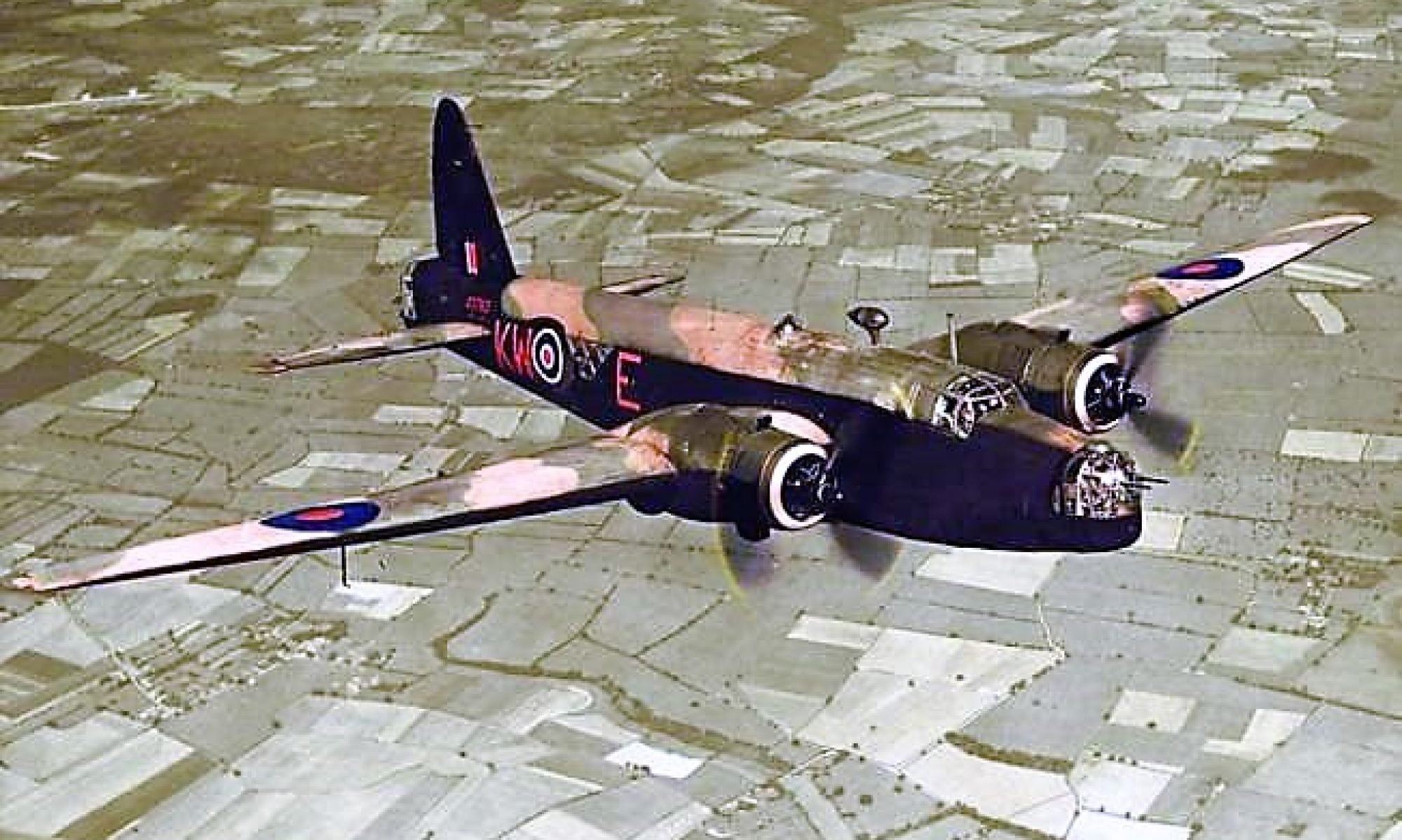


Mise à jour avec cette photo colorisée par Denis Thievin.
De la fille d’Antoine (Tony) Brassard DFC
De gauche à droite (tel que décrit par mon père dans une lettre envoyée à ma mère)
Jean (Jonny) Bourque de Montréal, navigateur. «Jeune homme sérieux avec beaucoup de plomb dans la tête».
R. Fuller d’Angleterre, ingénieur. «Exceptionnellement mon ingénieur était anglais, on manquait d’ingénieurs canadiens-français».
Gérard (Jerry) Lalonde, de Valleyfield, mitrailleur dorsal. «Très spirituel. C’est lui qui nous fait rigoler».
Georges (Blondy) Alarie de St-Jérome, Terrebonne, mitrailleur arrière. »Très jeune et très sensible«».
Antoine (Tony) Brassard de Strickland (Ontario), pilote et capitaine de l’équipage.
Philippe (Berny) Bernatchez de Baie-Comeau, bombardier (bomb aimer ou viseur de lance bombe). «C’est un type très intelligent. Il aime beaucoup taquiner mais se fait prendre dans son propre jeu».
Aimé Thievin de Saskatchewan, sans filiste. «C’est notre gars à tout faire, il est très adroit. Il travaille cinq minutes dans ta bicyclette et les cinq minutes suivantes dans ta montre».
This is what his grandson Rick posted on Facebook.

« Tupp » was part of « Turk » Turcotte’s crew.


Lloyd « Lucky Red » Stanley Lafoy, my Grandfather, enlisted in the RCAF in 1941 and like his sister, Violet Lafoy, hoped to work in the Mess Hall. Red only had a Grade 10 education and at that time one needed more to become an Airman. Losses were high however in the beginning of the war and Bomber Command lowered the entry standards allowing Red to enroll in Air Gunnery School in Paulson, Manitoba. An event that would change his life.
He would earn his Air Gunner Wing and by 1943 found himself in England assigned to 426 Thunderbird Squadron « On Wings of Fire ». His first pilot, Richard Talman, was a fellow Saskatchewan farm boy and would be Killed In Action flying as a « 2nd Dickey » (second pilot) with another crew training to take Red’s crew out. His bomber went down in Belgium and Talman’s grave is there now.


Red »s crew were now orphaned, without a pilot, and would be assigned to a new pilot, Felix-Henri « Turk » Turcotte, flying Wellington bombers over Europe and spend some time in North Africa bombing Italy.


They returned to England by ship and Red remembered that Air Gunners were always assigned to Submarine watch duty.
Back in the UK Red’s crew switched to flying Halifax MK III bombers with 425 Alouette Squadron « Je te plumerai » or « I shall pluck you » of No. 6 Group of Bomber Command.


Turcotte was not comfortable flying the Halifax however and the crew would disband for reassignment to new crews. Red would spend many months flying with Wing Commander Lucien « Joe the C.O. » Lecomte as his pilot.

They would bomb France, Belgium, and Germany for the duration of the war as Red completed his tour (30 missions).
Red would finish the war with 35 missions completed and was awaiting placement in the Pacific Theatre when the US would drop the atomic bombs ending the war.
To put things in perspective, Bomber Command lost a total of 8,325 aircraft. The crews also suffered a high casualty rate: 55,573 were killed out of a total of 125,000 aircrew, a 44.4% death rate. A further 8,403 men were wounded in action, and 9,838 became prisoners of war. During the RCAF’s Halifax operations between March 1943 and February 1944, the average loss rate was 6.05%, producing a mere 16% survival rate for a tour of 30 operations.
Red indeed was « Lucky » but always attributed his survival to the skill of his pilots. Talman was the only Airmen of his crews not to survive and Red never forgot him despite their brief history. He can be seen pointing to Spud’s name on the Bomber Command Memorial in Alberta.

Sargeant Richard « Spud » Elwood Talman – 20 years old, KIA, buried in Brussels Town Cemetery, Belgium. Son of Marion Hobart Talman and Annie Marguerite Talman, of Fertile, Saskatchewan, Canada.
Sadly « Red » passed away February 18, 2019 after a life well lived … and earned.

Lest We Forget.
Che Lafoy
 RCAF 425 Alouettes III